AI proposes. Accountable people decide.
Every process moves through a mandatory Author → Reviewer → Approver split. Roles are assigned, sign-off is explicit, and the record can’t be quietly edited later.
Separation of duties
The author can’t approve their own work. The split is enforced by default, and there is no silent way around it: an exception takes an administrator, a written justification, and its own entry in the log.
Append-only audit
Every state change is written to an append-only log. The application has no path that edits or deletes it — the exact boundary of that guarantee is spelled out on the security page.
One query away
When an auditor asks who approved what and when, the answer is on record — with a timestamp.
Decision tables (DMN) and tasks defined once go through the same sign-off. On request every signature is confirmed with a password, and every approval decision carries a content hash.
The loop, and the record it leaves.
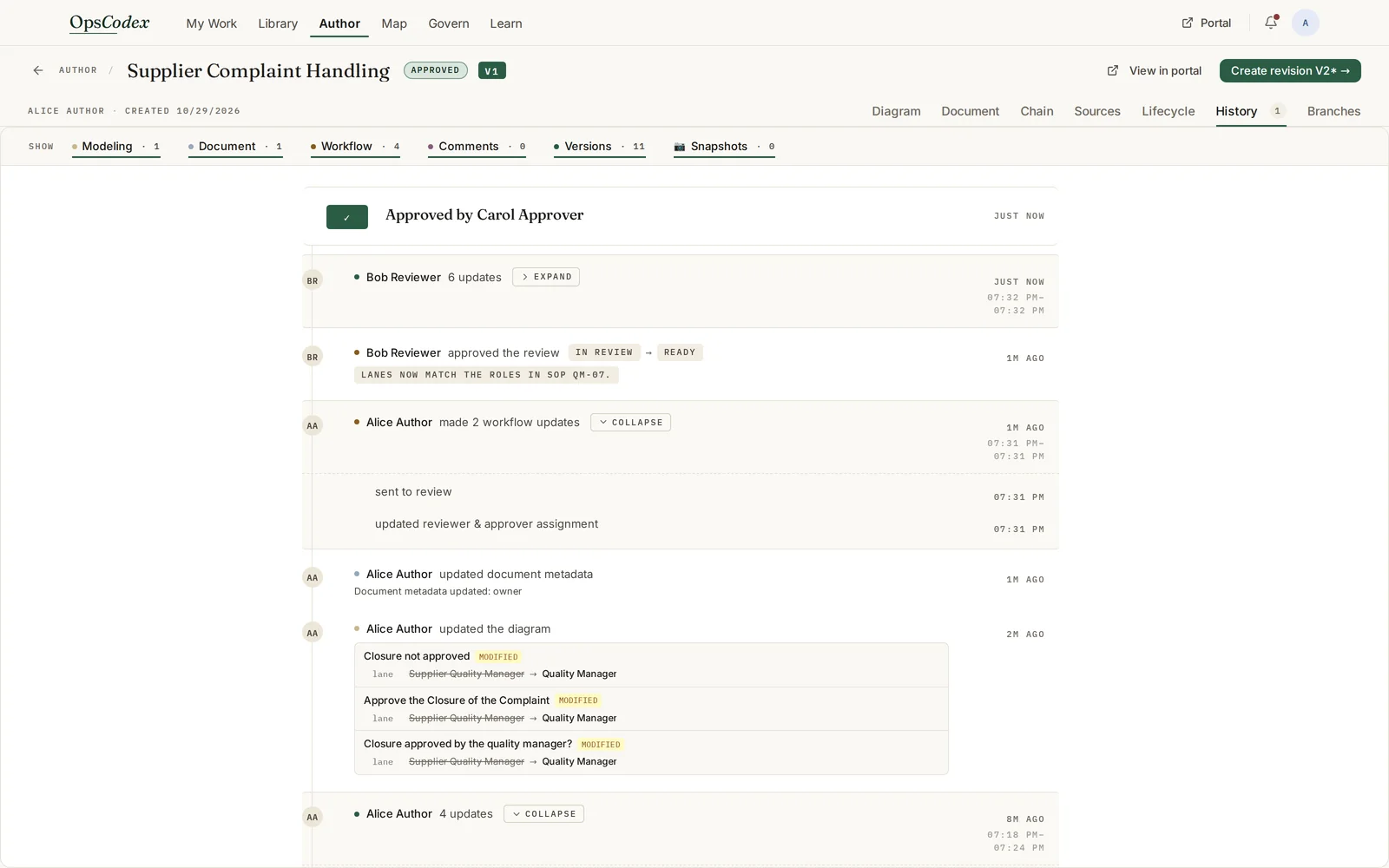
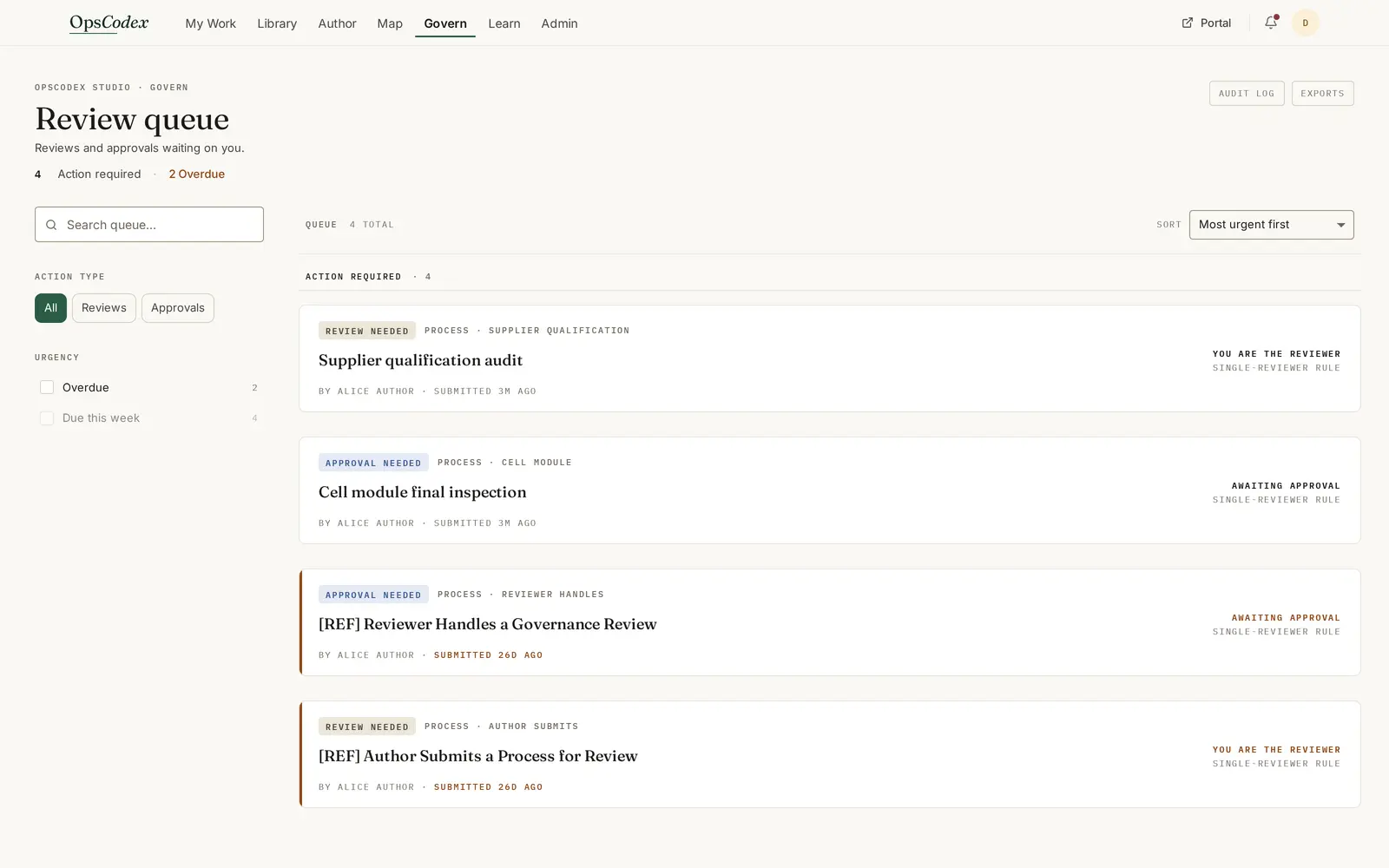
The auditor asks: who approved this?
Four folders. Two mail threads. One shrug.
One query. Author, reviewer, approver, timestamp, hash.
Sample dataExceptions take an administrator and a written justification, carry their own status, and can all be listed. Where the log's guarantee ends is stated openly on the security page. Security →
Your teams will use AI for process work — with or without control.
Somewhere in your organisation, someone is already pasting an SOP into a public chatbot and asking for a flowchart. The draft looks plausible. It carries no review, no approval, no audit trail — and by next week it’s the version people quietly work from. Ungoverned AI drafts are tomorrow’s audit findings.
The market is saying it itself.
The first Magic Quadrant for AI Governance Platforms.
Gartner builds quadrants for markets with real deployments and real buyers, not for ideas. Governance has become something procurement evaluates.
“who gets access to what, through which agent, and can you explain the decision trace afterward”
Gartner’s “Magic Quadrant for PLM Software in Discrete Manufacturing Industries” (June 9, 2026) is the first in 18 years — and this is the question that came with it, asked in an interview from inside the PLM market.
“Structure first. Intelligence follows. Improvement compounds.”
A MES CEO, publicly taking stock of his own industry: AI devalues twenty years of tooling differentiation. What remains is the correctly modelled operating model, enforced in execution.
Bring the process the auditor asked about last time.
Bring a PDF, a slide deck or a messy SOP, or use our sample data. In one hour we run the process end-to-end — draft, approval, export — and the concierge answers questions on it. Afterwards you get the process and an analysis report.

“In our consulting projects we spent weeks working through interviews, and in the workshop everyone still described the same process differently. Gaps and overlaps surfaced late, and the approved version vanished into a repository. We built OpsCodex for the whole road: from the draft through optimisation to the work that follows.”
Tillmann Schatz · Product owner OpsCodex, Senior Manager at Mews PartnersOpsCodex is built by a team at Mews Partners.